How to Make Bedtime Easier: A Calm Plan for Tired Families
Make bedtime easier with smoother transitions, screen-free alternatives, simple story choices and clear family roles.
How to Make Bedtime Easier: A Calm Plan for Tired Families
Key Takeaways
- ●Prepare the next bedtime step before the child needs it, and keep the routine short enough to repeat.
- ●Offer one bounded choice, choose one story and create a minimum version for difficult evenings.
- ●Use a story app as one routine component, while treating persistent or worrying sleep problems as a reason to seek professional guidance.
The short answer
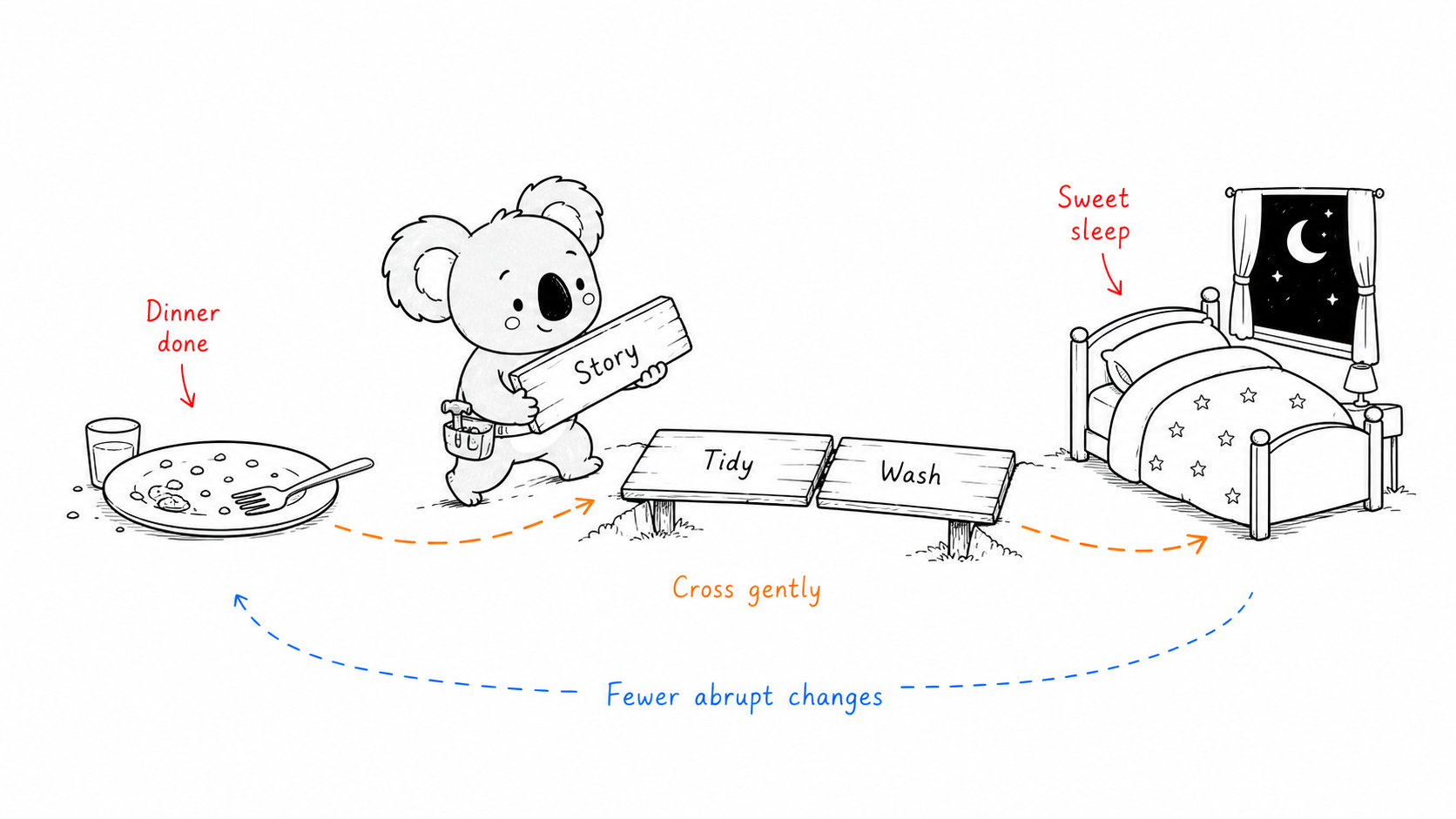
Bedtime becomes easier when the family has fewer decisions to make at the exact moment everyone is tired. Build a short bridge from the end of the day to bed: tidy one small area, wash and brush teeth, change into pyjamas, choose one story and use the same goodnight signal. Prepare the next step before it is needed, keep choices bounded and create a minimum version for difficult evenings.
This is a practical parenting plan, not a sleep treatment. The American Academy of Pediatrics recommends a quiet, consistent routine, and Raising Children Network describes a positive routine as helpful for many toddler settling concerns. If sleep problems are persistent, severe or worrying, or if a child snores or has loud or heavy breathing, speak with a qualified health professional.
Key takeaways
- ●Make the transition visible: say when bedtime is beginning and show what happens next.
- ●Use a familiar order rather than a long list of instructions.
- ●Offer two small choices, not an open-ended menu of activities.
- ●Prepare the story, pyjamas and comfort items before the hard part of the evening.
- ●Keep screens and exciting play away from the final part of the routine where possible.
- ●If more than one adult does bedtime, agree on the same boundary and final words.
- ●Treat a story app as a routine convenience, not a promise that a child will fall asleep.
- ●Track whether the evening is easier to repeat; do not judge the plan only by sleep speed.
Why tired families need a bridge
The transition from dinner, childcare or evening play to bed can feel like a cliff. One moment the child is active; the next, an adult is asking for teeth, pyjamas, water, a story and silence. Each request may be reasonable, but the sequence can feel sudden. A bridge adds small, predictable steps so the child does not have to switch from full energy to lights out in one move.
The bridge also protects the adult’s energy. If the parent decides the story, searches for a missing pyjama top and looks for a charger after the child is already overtired, the routine becomes reactive. Preparation moves some decisions earlier, when the family still has enough patience to make them calmly.
A good plan is not elaborate. It is the simplest sequence that meets ordinary needs and creates a clear ending. If the routine requires a special chart, a complicated reward system, several apps and a perfect room, it may not survive a normal school night. Build around actions that can be repeated with what the family already has.
Build the bridge after dinner
Step 1: Give a transition notice
Tell the child what is ending and what comes next. “After this song, we tidy the blocks” is more concrete than “Get ready for bed.” A visual timer can help some children, but it is optional. The tone should be steady rather than threatening.
If the child is in the middle of a game, allow one clear stopping point. Avoid promising an extra activity after the routine has started. The purpose of the notice is to reduce surprise, not to create a long countdown full of negotiations.
Step 2: Tidy one small area
Do not turn tidying into a full house reset. Choose one basket, one shelf or the floor beside the bed. The child can put away a few items while the adult narrates the transition: “The blocks are resting. Now we are going to wash.” This gives the body an action and makes the next step visible.
If the child is already overtired, skip tidying and use the minimum version. A calm bedtime is more important than a perfect living room.
Step 3: Finish practical needs
Use the bathroom, brush teeth, wash or bathe, put on pyjamas and prepare a safe comfort item. Check water, room temperature, night light and the door before the story. This reduces the chance that an ordinary need becomes a reason to restart the routine after goodnight.
The adult can say, “We have checked the practical things. Now it is story time.” That sentence creates a boundary without suggesting that the child must stop having needs. If the child genuinely becomes unwell or distressed, respond to that rather than following a script.
Step 4: Choose a story
Decide on one story before everyone is at the edge of patience. Offer two options if the child needs participation. If the family uses an app, the adult can open the story first, check the volume and manage the device. A physical book is equally valid and may be the easiest way to reduce screen decisions.
Gula Stories is designed for children aged 3–8 and offers age choices of 3–4, 5–6 and 7–8. Its documented product experience includes illustrated and narrated English stories, child-friendly English reading voices, autoplay, favourites, reading history and daily reading reminders. The app and website describe the experience as free from third-party advertising and intentionally simple and low-distraction.
These features can reduce searching, but they do not guarantee a calmer bedtime or make a child fall asleep. Gula Stories has no approved claim for offline listening, a sleep timer or listening-time limits. Subscription, favourites and reading progress can sync within iOS and Android separately, but iOS and Android accounts do not sync with each other. Families using more than one platform should check the current listing and choose the routine device deliberately.
Make a quiet basket, not a second entertainment zone
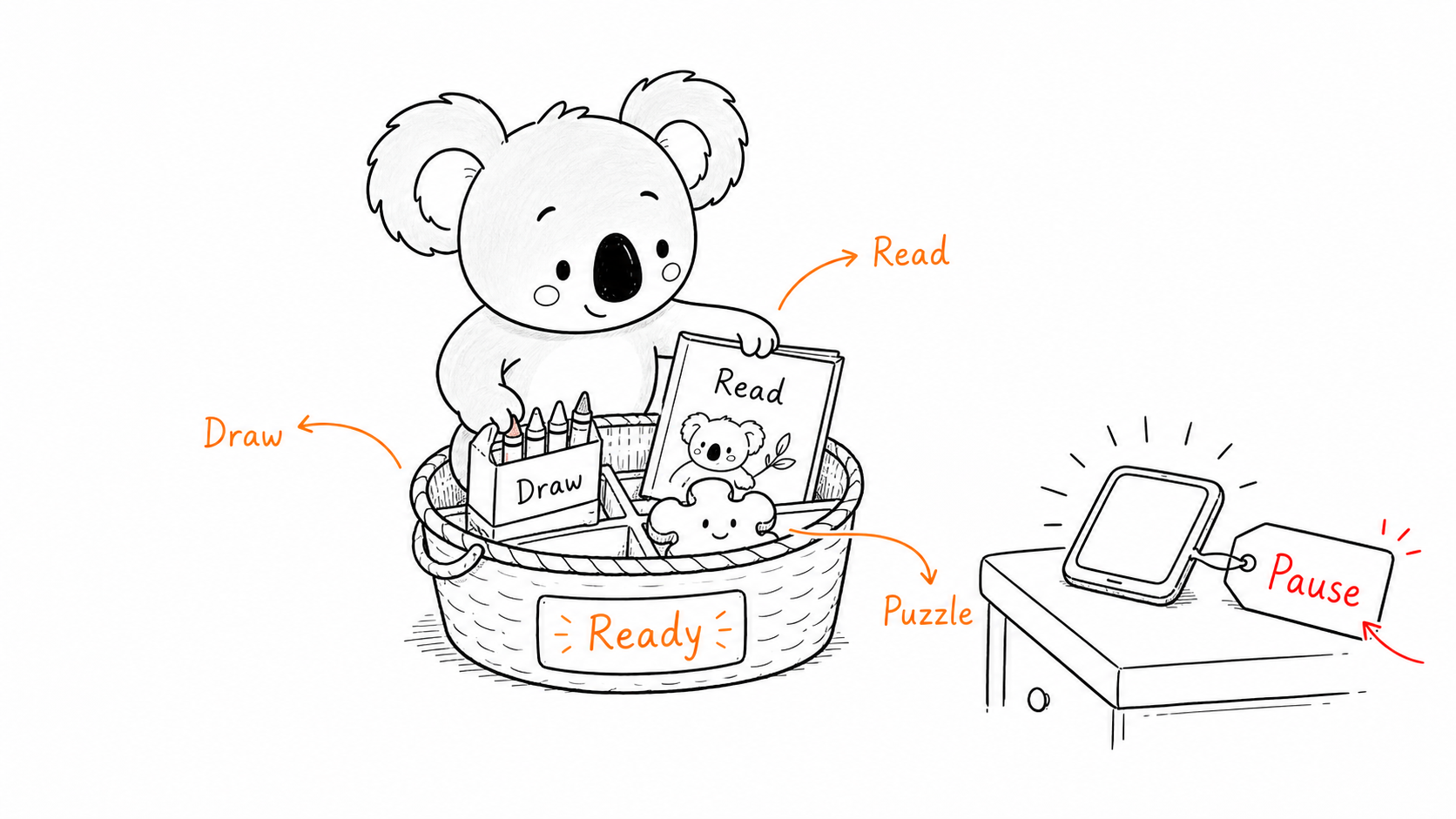
A prepared basket can help with the gap between dinner and the bedtime routine. Include a small number of quiet, familiar options: paper and crayons, a simple puzzle, a physical picture book or a soft toy. Keep it away from high-energy toys and remove items that turn the basket into a new collection to explore.
The basket is not a bribe. It is a way to make the next activity available without searching. The adult can say, “You may draw while I finish the dishes; then we start our bedtime bridge.” Use a timer or a clear stopping point if the child finds it hard to switch away.
For screen alternatives, a physical book, drawing, looking at family photos or listening to a parent tell a familiar story can work. If a digital story is the best fit on a particular night, keep the selection limited and avoid moving from story time into games, videos or unrelated browsing. A no-ad product can remove third-party interruptions, but it does not remove the parent’s role in setting the endpoint.
Use one shared plan across adults
When two adults share bedtime, the child should not have to discover which adult will offer the later ending. Before the routine begins, agree on:
| Decision | Example agreement |
|---|---|
| Story count | One story, with a second only on a planned special night |
| Choice | Child chooses between two titles already checked by an adult |
| Comfort | One drink, one comfort object and the usual night light |
| Final words | “The story is finished. You are safe. Goodnight.” |
| Call-out response | Check safety and needs, then return to the same brief reply |
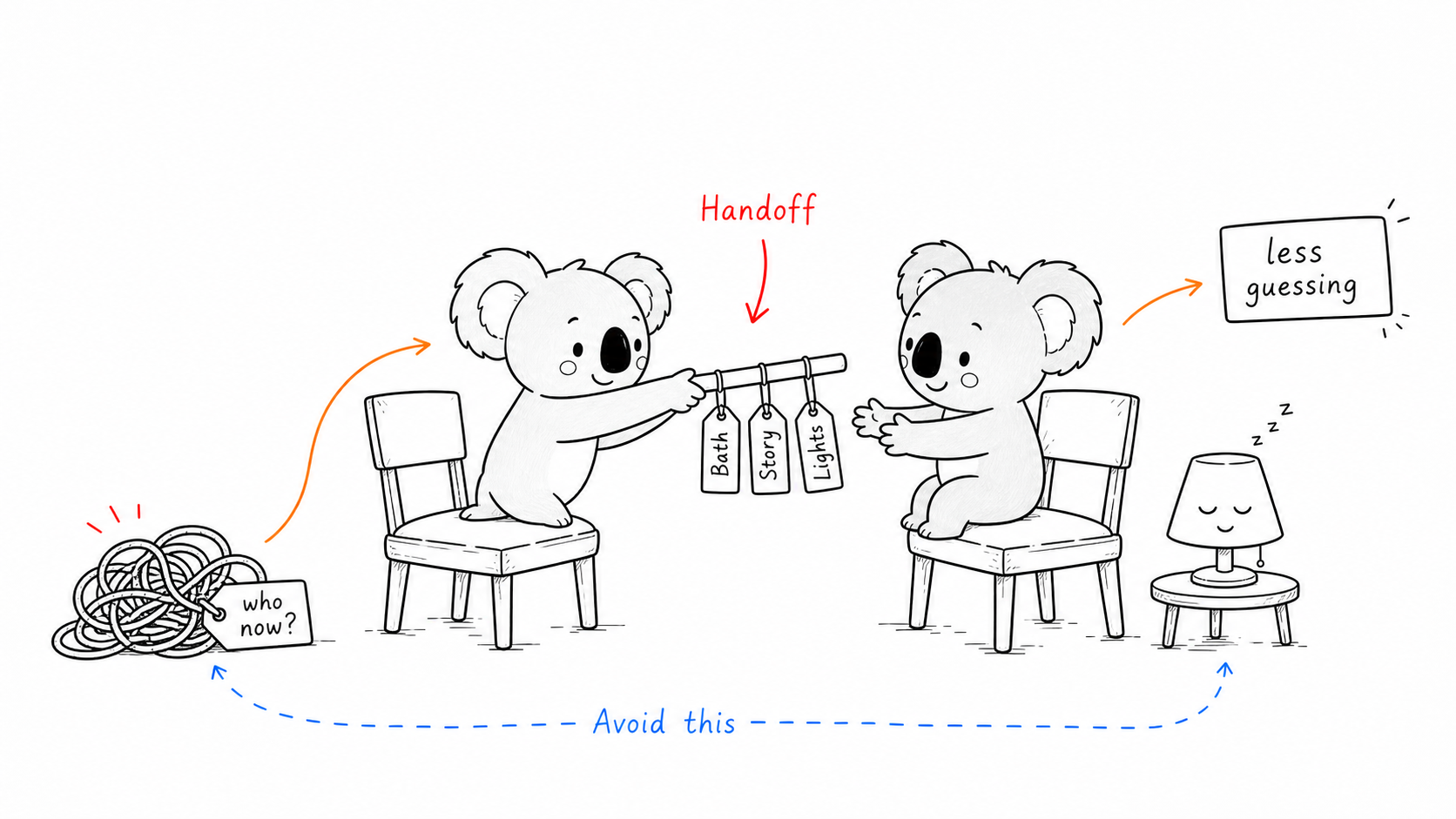
| Handoff | The second adult takes over at a named step rather than improvising |
The family can change the agreement later, but changing it in the middle of a negotiation makes the boundary less clear. A handoff can be as simple as “I am finishing teeth; you are doing the story and goodnight.” This reduces the child’s need to repeat the same request to two adults.
If one adult is unavailable, use the minimum version rather than trying to reproduce every detail. A routine that survives real life is more valuable than an ideal plan that only works when everyone has time and energy.
Make the ending visible
The ending deserves as much planning as the start. Close the book, turn off the app, use the same short phrase and leave. If a child asks for one more story, acknowledge the disappointment without adding another decision: “You wish there were another story. Tonight’s story is finished. Goodnight.” Then keep the response calm and brief.
Some families use a four-picture chart: wash, pyjamas, story, bed. Others use a small card that says “one last check” for water or the toilet. The tool should reduce words, not become a new achievement system. If the child is frustrated by the chart, remove it and keep the spoken sequence.
The same principle applies to autoplay. Autoplay may be convenient when a family wants a continuous listening experience, but it is not evidence that a longer session is appropriate. If the goal is one story before lights out, the parent should select one story and stop when it ends. Gula Stories’ approved facts do not include a sleep timer or listening-time limits, so families should not assume those features exist.
What to do on a difficult night
Use a “minimum bedtime” plan:
- ●Check safety and obvious needs.
- ●Brush teeth or complete the essential hygiene step.
- ●Put on pyjamas.
- ●Choose one very familiar story or read a few pages from a physical book.
- ●Use the usual final cue.
The minimum plan is not a punishment or a shortcut that has to be used forever. It is a way to avoid adding a long chain of instructions when the child is already overloaded. The next night, return to the full sequence if it is manageable.
If the child is hungry, unwell, unusually fearful or struggling after a major change, respond to the actual situation. A routine can provide a frame, but it cannot explain every behaviour. Avoid saying that the child is “bad at bedtime” or that the app has failed. Look for the smallest support that helps the family stay connected and safe.
Check the content before making it part of the routine
Parents comparing story apps can use the following checklist:
| Question | Why it matters |
|---|---|
| Is the age range clear? | A 3-year-old and an 8-year-old may need different language and themes |
| Is there a content review statement? | It tells the parent what happens before a story reaches the child |
| Are unsuitable themes named? | “Family-friendly” is broad; explicit exclusions are easier to evaluate |
| Are third-party ads absent? | Ads can add interruptions or messages the parent did not choose |
| Can the adult pick one story quickly? | Searching can extend the routine at the hardest moment |
| Is there a clear ending? | The last transition matters as much as the story itself |
| Are billing and platform terms clear? | A trial and a subscription are not the same thing |
Gula Stories documents AI-assisted story creation and selection followed by team rewriting and review for children. Stories are reviewed for age suitability before release, with violence, sexual content and other unsuitable material excluded. This is useful evidence about process, but it does not replace parental judgement. A parent may still choose a different story for a particular child on a particular night.
Notice progress without creating pressure
A bedtime plan is becoming easier when the family sees practical changes:
- ●The child recognises the first signal and starts moving towards the next step.
- ●Fewer items are needed in the quiet basket.
- ●The adult chooses the story before the child becomes overtired.
- ●The child accepts one of two choices more often.
- ●The story ends without a new browsing session.
- ●The final phrase is familiar to everyone.
- ●Adults respond in the same way after a call-out.
These are process measures, not promises about sleep. Some evenings will still be difficult. Illness, travel, developmental changes and family stress can alter bedtime. Return to the bridge and the anchors instead of adding more rules.
When to get professional advice
This article is general parenting information, not medical advice. Seek advice from a qualified health professional if sleep problems are persistent, severe or worrying, or if the child snores, has loud or heavy breathing, seems to have pain or is very sleepy during the day. A clinician can consider the child’s individual health and development; a story app cannot.
Parents should also be cautious about marketing that says an app will make children fall asleep, cure anxiety, solve fear of the dark or fix bedtime refusal. A story can be part of a gentle routine, but it is not a medical or mental-health treatment. Honest product language is a quality signal because it makes the boundary clear.
FAQ
What is the fastest way to make bedtime easier?
There is no reliable instant fix. Start with one change that reduces decisions: prepare the pyjamas and story earlier, then use the same order and final cue for several evenings. Judge the plan by whether the family can repeat it and whether negotiations become shorter.
How many choices should a child have at bedtime?
One small choice is often enough: two pyjama sets, two stories or two comfort options. Keep the larger boundary fixed. More choices may sound generous but can create more energy and delay when the child is tired.
Is a quiet basket better than a screen?
It depends on the child and the timing. A basket with drawing, a physical book or a simple puzzle gives the family non-screen options, while a carefully managed story app may be useful when an adult needs a prepared story. Whichever tool is used, keep the final part of the routine predictable and avoid unrelated entertainment.
Are bedtime story apps safe for young children?
Safety depends on the content process, age fit, advertising, design and parent control. Gula Stories describes AI-assisted creation followed by team review, explicit exclusion of violence, sexual content and other unsuitable material, and an experience free from third-party advertising. Parents should still preview stories and supervise the routine.
Does Gula Stories have a sleep timer or offline stories?
Those are not approved Gula Stories feature claims, so this article does not promise them. Check the current official store listing if either feature is essential. The app should not be marketed as an offline, timer-enabled or sleep-treatment service without current evidence.
Can iPhone and Android users share Gula Stories progress?
No. Subscription, favourites and reading progress can sync within iOS and within Android, but iOS and Android accounts do not sync with each other. Families using both platforms should plan around that limitation.
What if one parent is stricter than the other?
Agree on a small set of shared boundaries before bedtime: the number of stories, the practical checks, the final phrase and the response to call-outs. Adults can have different styles while keeping the sequence recognisable for the child.
Can this plan solve bedtime refusal?
No plan or app should promise that. A predictable routine may reduce some negotiation, but persistent or concerning sleep problems need individual professional advice.
Conclusion
To make bedtime easier for tired families, build a bridge rather than adding pressure. Give notice, tidy one small area, finish practical needs, change into pyjamas, choose one suitable story and use the same final cue. Prepare a quiet basket, coordinate adult handoffs and keep a minimum version for difficult nights. Track the repeatability of the process instead of demanding perfect sleep.
Gula Stories can support the story step for families looking for English illustrated and narrated stories for ages 3–8, age choices of 3–4, 5–6 and 7–8, child-friendly English reading voices, autoplay, favourites, reading history, daily reminders and no third-party advertising. Explore the library and current plans, while remembering that the app is a parenting convenience tool rather than medical, mental-health or sleep-treatment advice.
Sources checked for general guidance
- ●American Academy of Pediatrics: Toddler Bedtime Trouble
- ●HealthyChildren.org: Healthy Sleep Habits
- ●Raising Children Network: Toddler sleep
This article provides general parenting information, not medical advice. Product features and subscription terms can change; check official listings before use or purchase.