The Science of Why Bedtime Stories Help Kids Sleep Better
Bedtime stories may support better sleep by creating a predictable transition from daytime activity to rest. Calm, repea
The Science of Why Bedtime Stories Help Kids Sleep Better
Core Summary
- ●Bedtime stories may support better sleep by creating a predictable transition from daytime activity to rest.
- ●Calm, repeated storytelling can reduce stimulation, focus a child’s attention and strengthen positive bedtime associations.
- ●The greatest benefit usually comes from the routine surrounding the story, not from any single book, voice or app.
- ●Parents should choose age-appropriate stories, keep the experience low-distraction and respond to the child’s individual needs.
- ●Bedtime stories can support healthy routines, but they should not be presented as a treatment for anxiety, persistent sleep problems or bedtime refusal.
1. Introduction
Bedtime can be difficult for young children and exhausting for parents. A child may still feel energetic, ask for repeated drinks or questions, resist separation, or struggle to shift attention away from play. Parents often want a gentle activity that marks the end of the day without turning bedtime into another negotiation.
Reading or listening to a bedtime story can help because it combines several useful elements: predictability, focused attention, emotional connection and a gradual reduction in stimulation. These elements may make the transition towards sleep feel safer and easier. However, a bedtime story does not directly “cause” sleep, and no story format can guarantee that a child will fall asleep quickly.
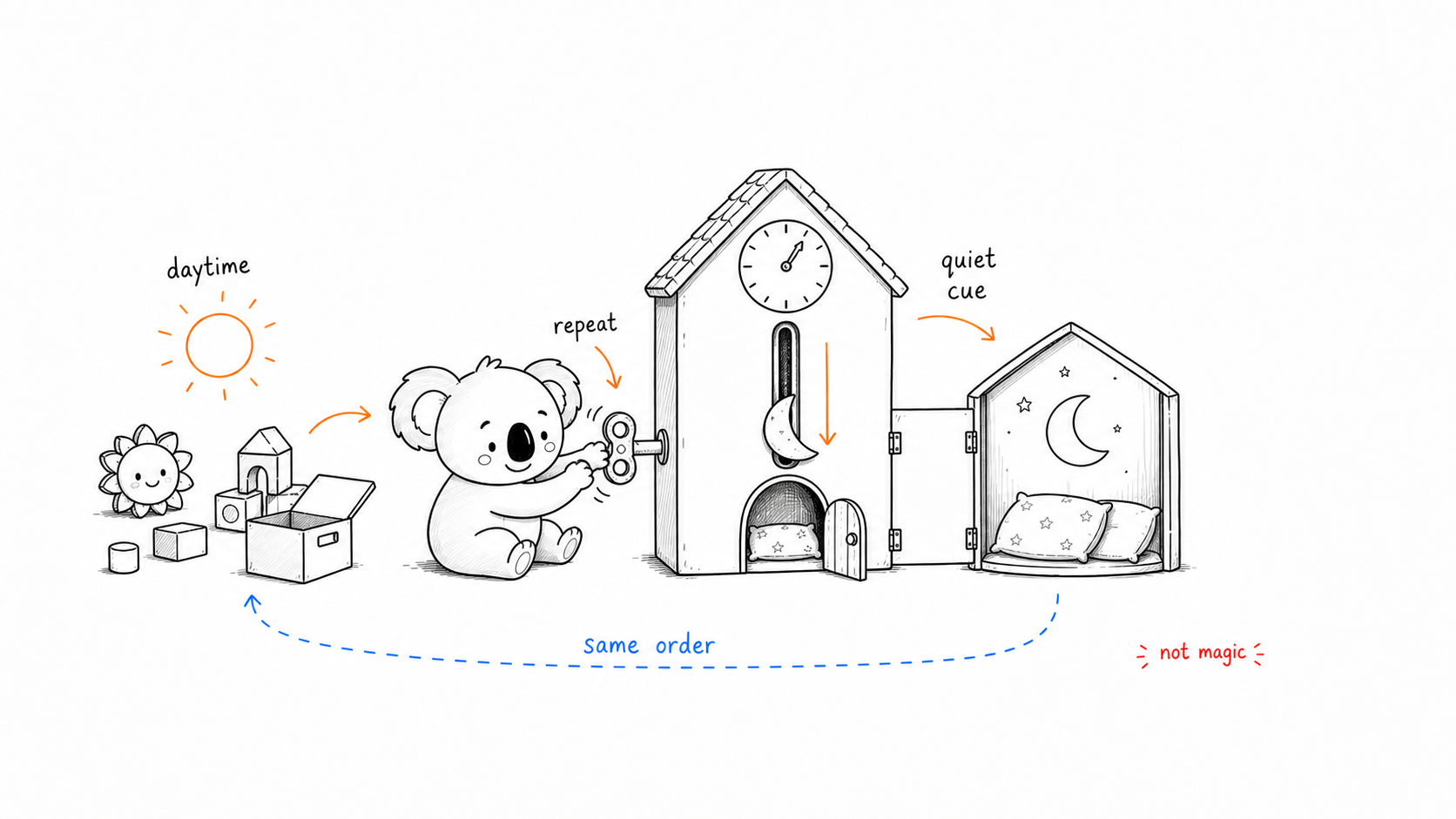
The practical question is therefore not whether stories work like medicine. It is how families can use storytelling to build conditions that are more compatible with rest. This article explains the main mechanisms, how to choose stories for different ages and where the limits of storytelling should be recognised.
2. Predictable Stories Create a Clear Bedtime Signal
Core conclusion: A regular story can become a reliable cue that daytime activity is ending.
Young children often manage transitions more easily when events happen in a familiar order. A routine such as bath, pyjamas, toothbrushing, story and lights out reduces uncertainty about what happens next. When repeated consistently, the story occupies a specific place in that sequence.
The value lies partly in repetition. The child does not need to decide whether bedtime has started or wonder what the parent expects. The familiar sequence communicates that active play is finished and the household is moving towards a quieter state.
This does not mean every evening must follow an exact timetable. Families can preserve the pattern even when the clock changes. A short version of the routine may still be useful on busy nights.
A practical sequence might be:
- ●Put away stimulating toys and screens.
- ●Complete washing and toothbrushing.
- ●Move to the usual reading place.
- ●Read one short story at a calm pace.
- ●Use the same simple closing phrase.
- ●Dim or switch off the light.
Daily reading reminders may help families make story time a regular part of the evening, although reminders support consistency rather than producing sleep themselves [K1].
3. Storytelling Redirects Attention Without Demanding Activity
Core conclusion: A calm narrative gives the mind something structured to follow while reducing the need for physical participation.
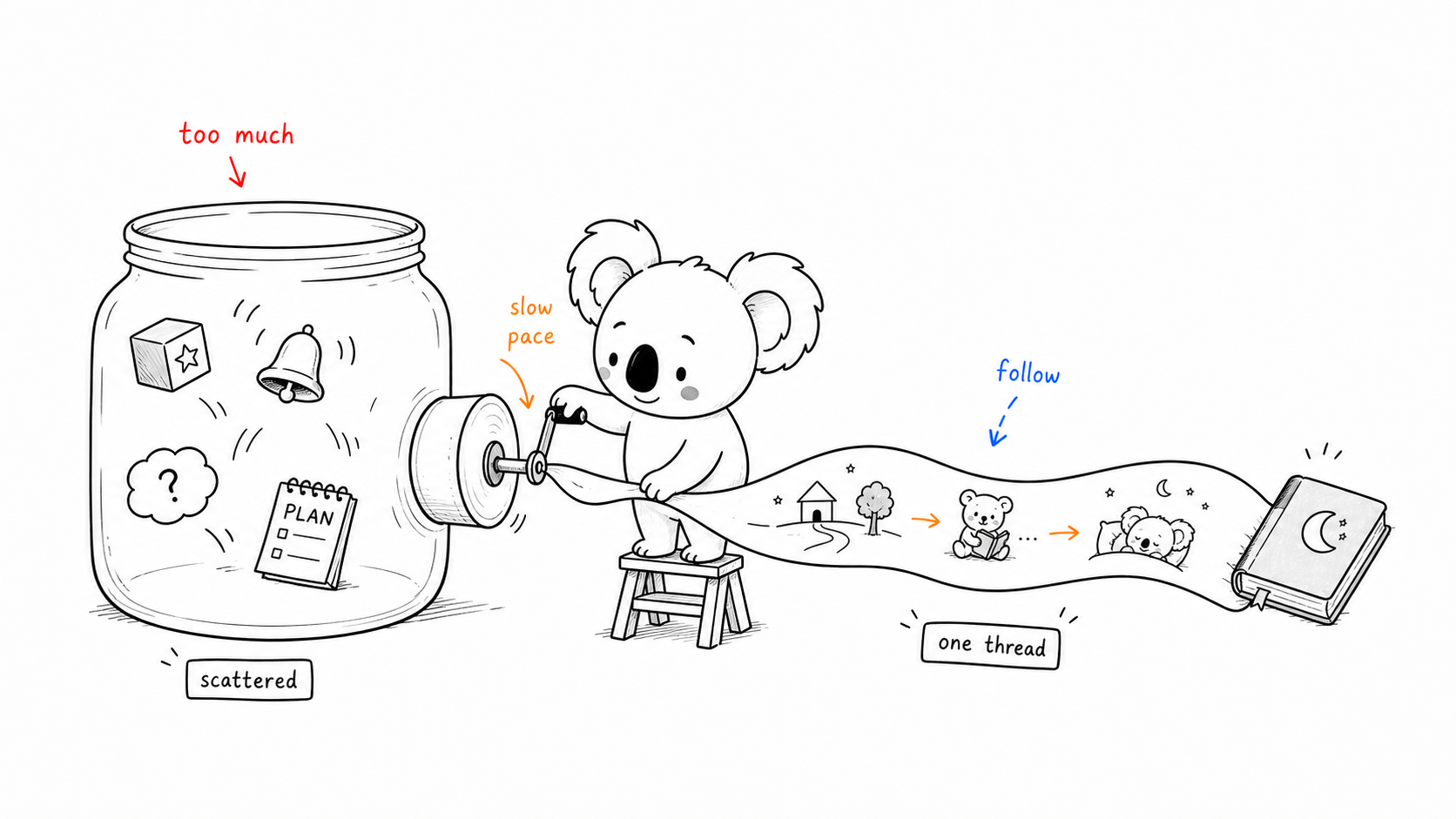
Before bed, a child’s attention may jump between toys, noises, unfinished plans and requests. A story narrows that field. Instead of choosing the next activity, the child follows characters, events and repeated phrases within a defined narrative.
This form of attention is different from highly interactive entertainment. Fast visual changes, rewards, games and repeated choices can invite continued participation. A simple story can hold attention without requiring the child to keep acting.
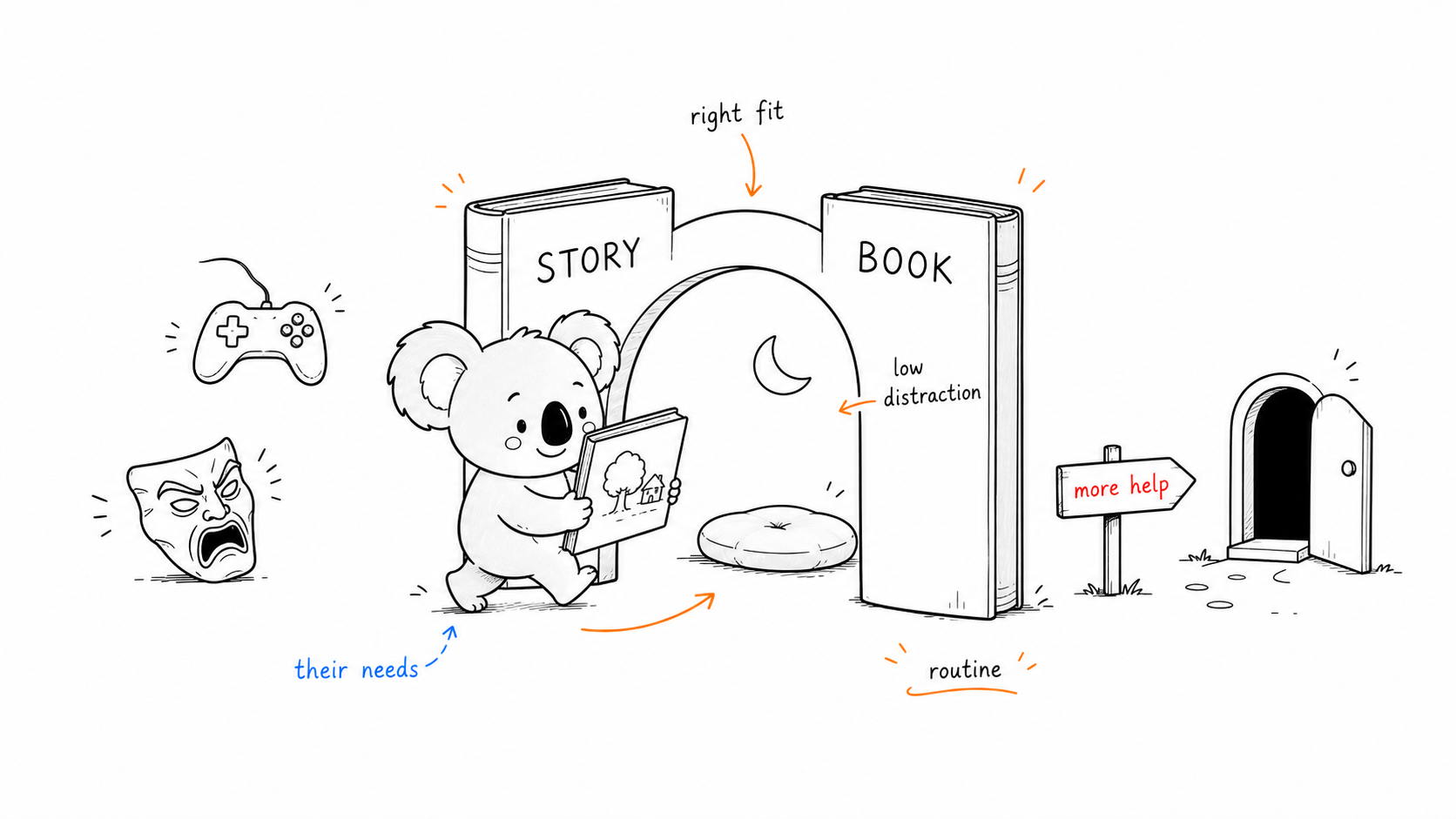
The delivery matters as much as the plot. A frightening story read dramatically may increase alertness, while a familiar story read slowly may feel settling. Parents can support a quieter experience by:
- ●using a steady voice;
- ●reducing background noise;
- ●keeping questions brief;
- ●avoiding games or competitive activities during the story;
- ●choosing a story with a clear, reassuring ending;
- ●stopping after the agreed number of stories.
For digital storytelling, a low-distraction interface is preferable to an experience built around constant interaction. Gula Stories is designed to help children focus on stories through a deliberately simple experience rather than placing games or AI features at the centre [K5]. This design choice may support immersion, but it should not be interpreted as proof that the app makes children fall asleep.
4. Shared Stories Can Support Emotional Settling
Core conclusion: Story time may help children settle emotionally because it offers connection, reassurance and a contained space for processing everyday feelings.
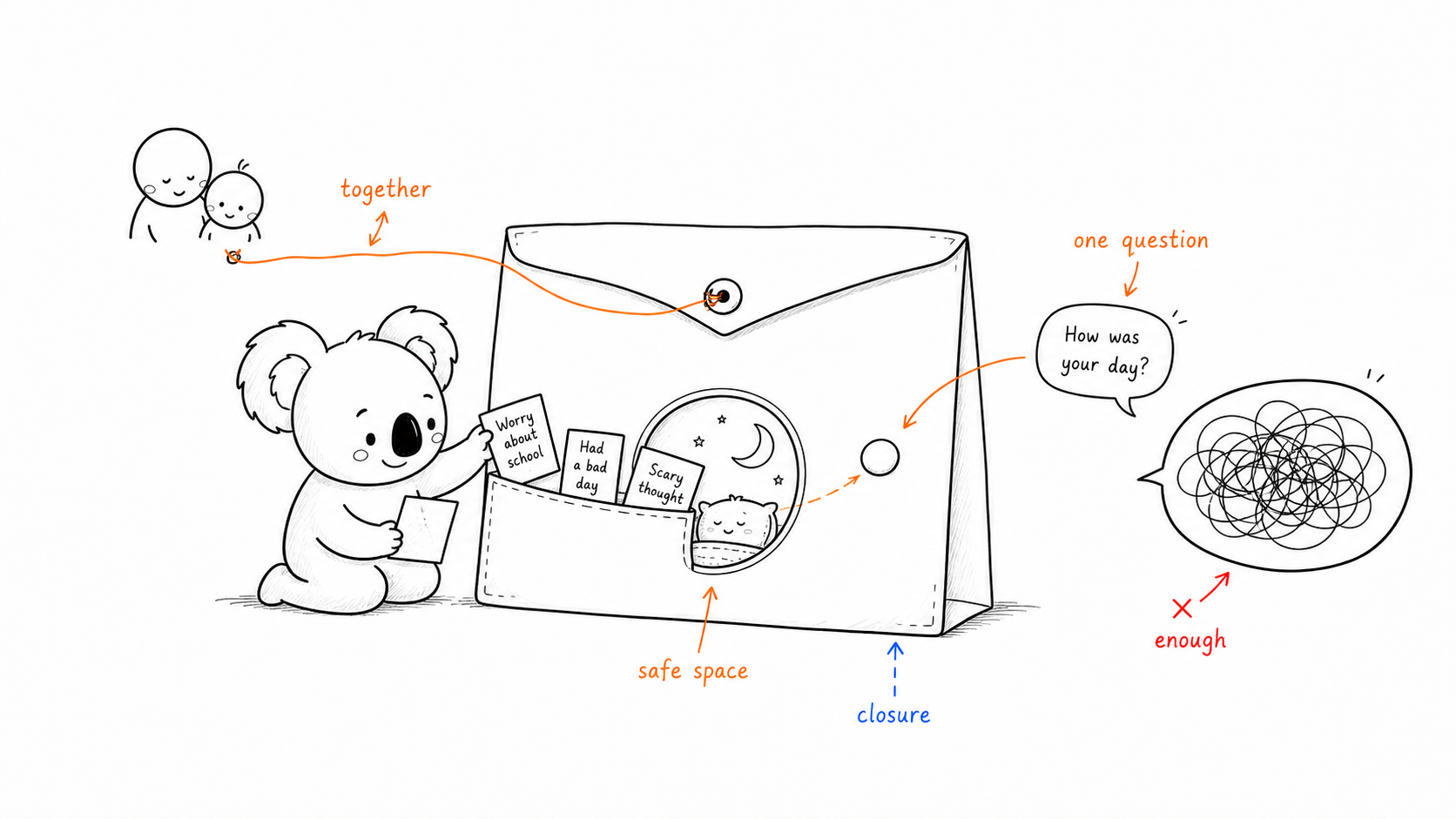
For many children, bedtime involves separation from a parent or caregiver. Sitting together for a story can provide a predictable period of attention before that separation. The parent’s presence, voice and responsiveness may be as important as the story itself.
Stories can also give children indirect ways to explore emotions. A character might feel worried about a new experience, frustrated by a mistake or comforted after being frightened. Discussing the character can be easier than asking a child to explain personal feelings directly.
The conversation should remain proportionate to bedtime. If every emotional theme becomes a long discussion, story time may become more activating than settling. A parent might use one brief prompt, such as:
- ●“How do you think the character felt?”
- ●“What helped them feel safe?”
- ●“What was your favourite part?”
The answer does not need to be analysed. The goal is connection and closure, not a formal lesson.
Stories should also be chosen carefully for children who are sensitive to danger, separation or suspense. Even books that adults consider harmless can feel intense to a particular child. If a story repeatedly leads to fear or more bedtime questions, replace it with something gentler or read it earlier in the day.
5. Age-Appropriate Choices Make the Routine Easier to Sustain
Core conclusion: The best bedtime story is one that matches the child’s attention, comprehension and emotional comfort.
Age ranges are useful starting points, but they are not strict developmental rules. Some three-year-olds enjoy a longer narrative, while some seven-year-olds prefer short, familiar stories when tired. Parents should observe the child’s response rather than treating an age label as a guarantee.
| Age range | Helpful story characteristics | Possible difficulty | Practical approach |
|---|---|---|---|
| 3–4 | Short plots, repetition, familiar objects and reassuring endings | Losing track of complex events | Choose one simple story and allow limited repetition |
| 5–6 | Clear sequences, gentle humour and manageable problems | Becoming excited by action or suspense | Select calmer plots and pause only for brief questions |
| 7–8 | Richer characters, chapters and reflective themes | Wanting to continue beyond bedtime | Agree on a stopping point before reading begins |
Gula Stories identifies parents of children aged 3–8 as its broader audience, with an initial content focus on ages 3–4 [K4]. Its app allows parents to select story ranges for ages 3–4, 5–6 and 7–8, which can make initial selection easier [K5]. The current stories are in English [K4].
Parents should still preview unfamiliar stories. An age category cannot account for every child’s language ability, interests, fears or family circumstances.
6. A Practical Bedtime Story Method and Its Limits
A useful routine should be simple enough to repeat, flexible enough for real family life and clear enough to prevent story time from expanding indefinitely.
| Element | More supportive approach | Less supportive approach |
|---|---|---|
| Timing | Begin before the child becomes extremely overtired | Wait until conflict has already escalated |
| Environment | Use soft lighting and reduce unrelated noise | Keep bright screens or active toys nearby |
| Story choice | Select familiar, age-appropriate and emotionally gentle material | Choose intense suspense or stimulating interactive content |
| Duration | Set a clear, manageable limit | Negotiate additional stories repeatedly |
| Delivery | Read or play the story at a steady pace | Use an increasingly dramatic or energetic performance |
| Ending | Use a consistent closing phrase and move towards lights out | Introduce a new activity after the story |
| Expectations | Treat stories as one part of a routine | Expect a story to guarantee sleep |
Families using Gula Stories can access child-friendly English reading voices, autoplay, favourites and reading history [K5]. These functions can reduce the effort involved in choosing and continuing stories, particularly when a parent is tired. The app is available on iOS and Android outside mainland China, including Australia, New Zealand, the United Kingdom and the United States [K3].
There are important boundaries. It would be inaccurate to claim that the app makes children fall asleep, treats anxiety, cures fear of the dark, resolves bedtime refusal or guarantees a calmer evening [K1]. Families should also avoid assuming that it provides offline listening, downloads, a sleep timer, listening-time limits or human narration, as those claims are not supported by the approved product information [K1].
Subscription, favourites and reading progress can sync between iPhone and iPad within iOS, and between Android devices within Android. Accounts do not sync across iOS and Android [K5].
7. Frequently Asked Questions
Q1. How long should a bedtime story be?
There is no universal duration. The story should be long enough to create a calm transition but short enough to fit the family’s routine consistently. For younger children, one brief story may be more sustainable than a long session. A clear limit is usually more helpful than choosing an ambitious duration that changes every night.
Q2. Is listening to a story as useful as reading together?
Listening can still provide narrative structure and focused attention. However, reading together adds direct interaction with a parent or caregiver. Families can use either approach according to their circumstances. When using recorded narration, keeping the environment simple and avoiding unrelated screen interaction may help preserve the low-stimulation character of the routine.
Q3. Should children hear the same story repeatedly?
Repetition can be useful. A familiar story reduces uncertainty and allows the child to anticipate what comes next. Parents do not need to introduce new material every night. If repetition becomes frustrating for the adult, a small rotation of familiar stories can provide variety without making bedtime unpredictable.
Q4. When is a bedtime story not enough?
A story is not a medical or behavioural treatment. If a child regularly experiences severe distress, breathing difficulties, unusual night-time behaviour, persistent sleep disruption or problems that affect daytime functioning, parents should seek guidance from an appropriately qualified health professional. Story time can remain a comforting routine, but it should not replace individual assessment.
8. Conclusion
Bedtime stories may help children sleep better by supporting the transition into rest: they create a predictable cue, narrow attention, reduce demands for activity and offer a period of connection before separation. Their effect depends on the wider routine, the child’s needs and the way the story is delivered.
For most families, the strongest starting point is modest: choose one age-appropriate story, reduce distractions, keep the sequence consistent and end clearly. Books, spoken stories and carefully designed digital options can all serve this purpose. The objective is not to force sleep or promise a conflict-free bedtime. It is to give the child a gentle, repeatable path from the activity of the day towards rest.