How to Choose a Bedtime Story App for 3- to 4-Year-Olds
A practical guide to choosing a bedtime story app for 3- to 4-year-olds, covering age fit, distraction-free design, content safety and everyday routines.
How to Choose a Bedtime Story App for 3- to 4-Year-Olds
Key takeaways
- ●Choose stories created specifically for preschool-aged children, with clear language, manageable plots and themes that suit your child’s interests.
- ●Look for a calm, low-distraction experience that makes it easy to find and begin a story.
- ●Check how stories are reviewed, what unsuitable material is excluded and whether third-party advertising appears in the experience.
- ●Treat the app as one part of a familiar family routine, not as a product that guarantees sleep or solves bedtime difficulties.
- ●Review the subscription terms, trial conditions, language and regional availability before signing up.
- ●Try the app with your child and pay attention to their response. The right choice should work for your particular family, not merely satisfy a general checklist.
Choosing a bedtime story app for 3- to 4-year-olds can feel surprisingly complicated. Parents may encounter large libraries, colourful interfaces, subscription offers and broad promises, all while trying to make a decision at the end of an already busy day.
At this age, children are developing rapidly. They may enjoy repetition, simple adventures, playful characters and stories connected to familiar experiences. Their attention can also shift quickly, especially when an app contains too many buttons, menus or competing activities. A suitable bedtime story app should therefore offer more than a collection of children’s content. It should help parents choose an appropriate story without adding unnecessary effort or stimulation.
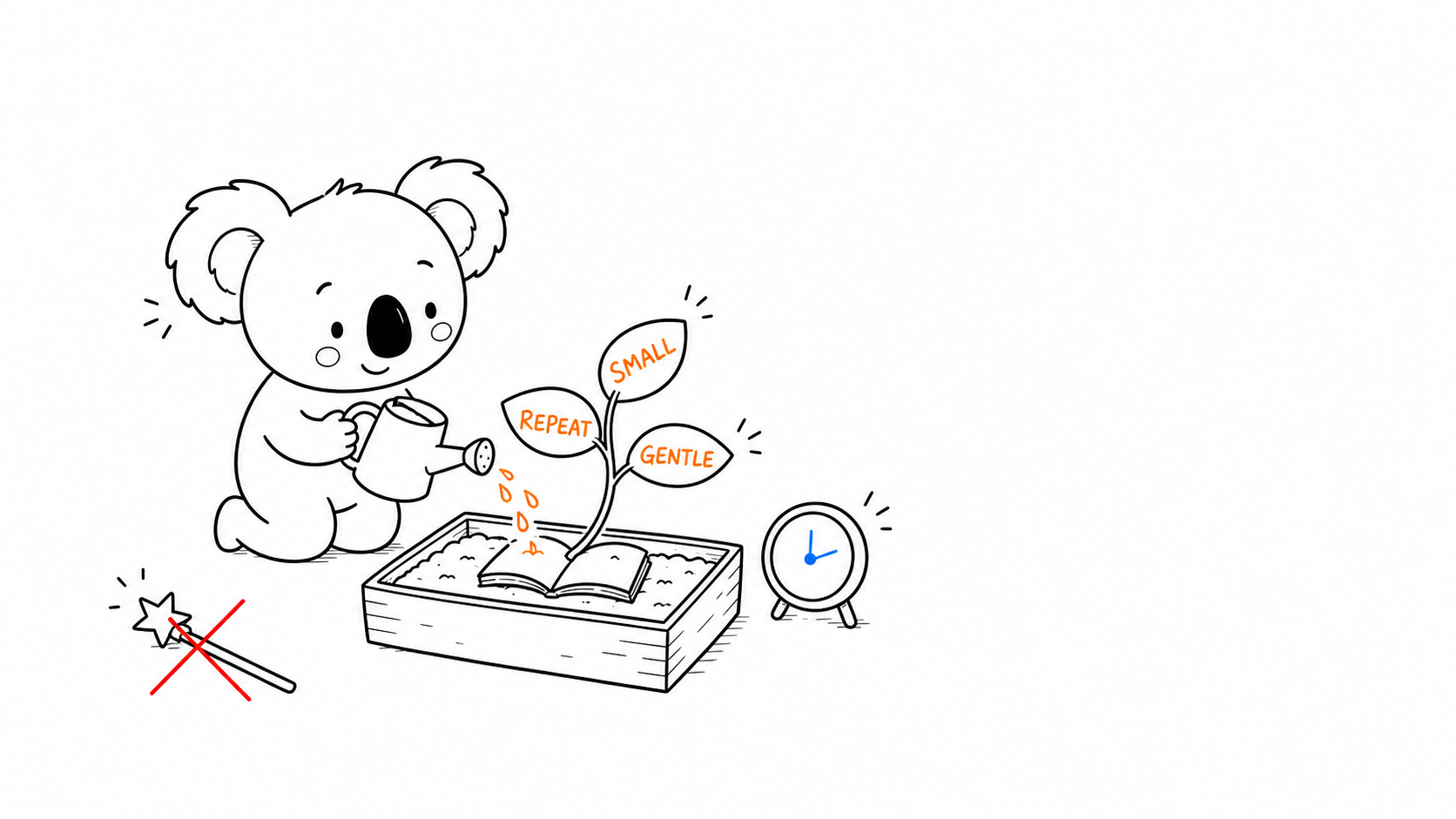
No app can guarantee that a child will fall asleep, remove fears, treat anxiety or resolve bedtime refusal. Sleep and bedtime behaviour are influenced by many factors, and every child is different. A story app is better understood as a practical reading tool: something that can help a tired parent begin a gentle, repeatable story-time routine.
The following four criteria can help you assess whether an app is a good fit for your 3- or 4-year-old.
1. Start with age fit, not just the "kids" label
A general children’s label does not tell you whether a story will suit a preschooler. Content made for an 8-year-old may have longer plots, more characters and more complex emotional ideas than a 3-year-old can comfortably follow. When comparing apps, look for meaningful age guidance rather than relying only on a broad category.
For children aged 3 to 4, useful stories often have:
- ●A clear beginning, middle and end
- ●A small number of easy-to-follow characters
- ●Familiar situations or simple imaginative adventures
- ●Language that sounds natural when read aloud
- ●Themes that can be understood without lengthy explanations
- ●A length that suits the child’s current attention span
- ●Enough repetition or predictability to encourage participation
Age fit is not simply about making every story extremely short. Some preschoolers happily follow a longer story when it matches their interests, while others prefer a quick tale after an active day. The more useful question is whether the app helps you make an appropriate choice without requiring you to open and assess many unsuitable options.
Look for age categories, age-based recommendations or descriptions that give you a reasonable sense of each story before you begin. Age-based story choices can reduce decision fatigue, particularly when you are choosing between several appealing titles.
Your child’s individual preferences matter as much as the age label. One child may enjoy gentle animal adventures, while another may prefer imaginative journeys or stories about everyday routines. An age category should narrow the field, but it should not replace your judgement.
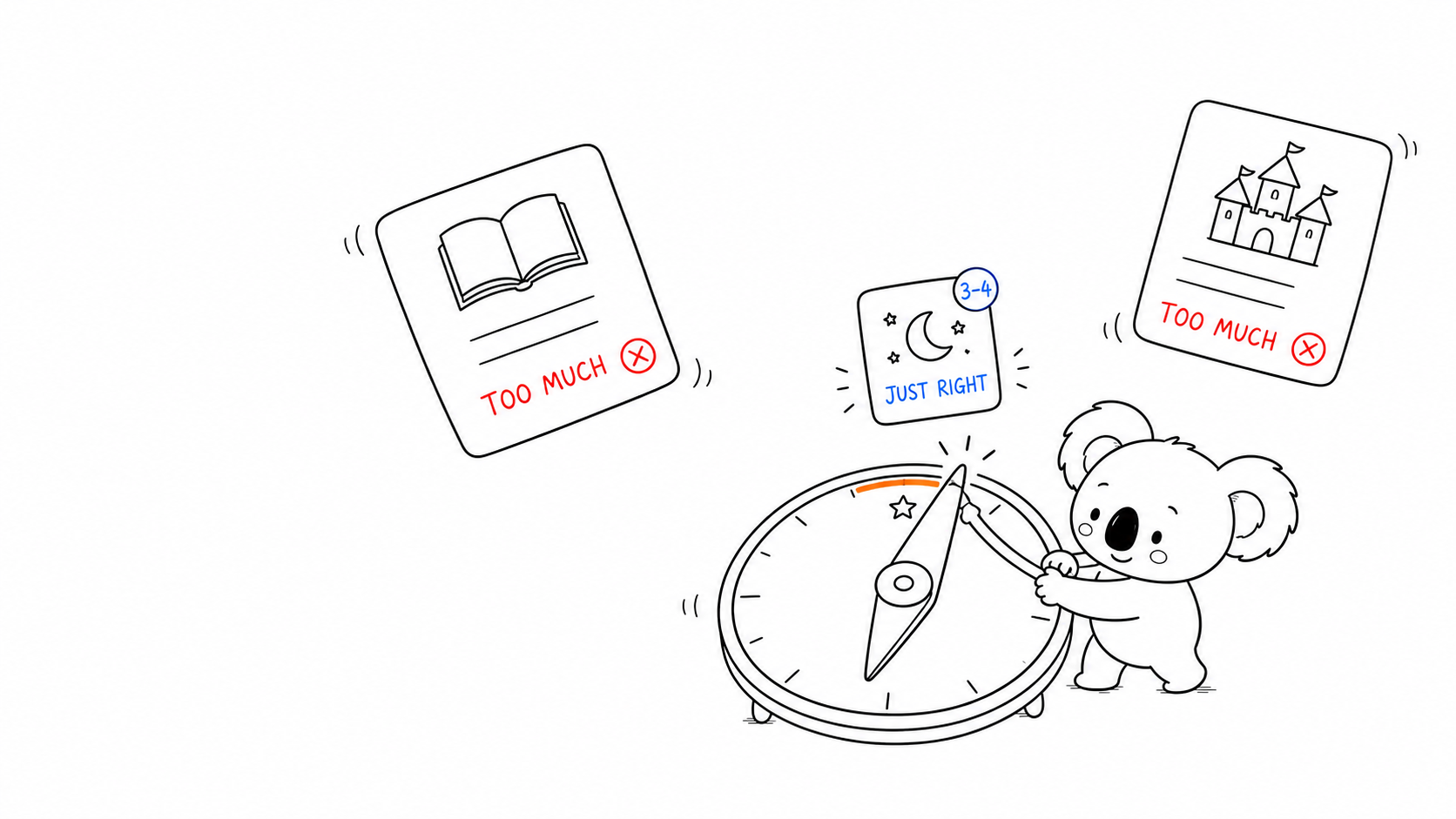
When trying an app, observe whether your child can follow the main idea, anticipate parts of the story or talk about a character afterwards. These responses can help you understand whether the content is at a comfortable level. If your child repeatedly loses interest or becomes confused, try a simpler story or a different theme rather than assuming the entire app is unsuitable.
2. Look for a calm, low-distraction experience
A bedtime app should make starting a story straightforward. Complicated navigation, constant prompts, bright rewards or an excess of choices can turn a simple family activity into another task to manage.
Before subscribing, explore the experience from a parent’s perspective. Can you find an age-appropriate story quickly? Are titles and categories understandable? Can you move from opening the app to beginning a story without passing through several unrelated screens?
A low-distraction experience may include:
- ●Clear navigation
- ●Readable text
- ●Simple story categories
- ●A manageable number of decisions on each screen
- ●Few interruptions during the story
- ●No unrelated games or attention-seeking features in the reading flow
- ●An easy way to return to familiar content
The design does not need to be dull. Warm illustrations and appealing characters can invite children into a story. The goal is to avoid features that compete with the story itself.
Consider how your family will use the app. Some parents may read from the screen while sitting beside their child. Others may use the app to choose a story and then focus on listening or reading together. In either case, the device should support the shared activity rather than becoming its centre.
You can also reduce distraction through your own routine. Choose the story before getting into bed, lower the device brightness if appropriate, silence unrelated notifications and place the device where both parent and child can follow comfortably. These small choices can make the experience feel more intentional.
A favourites list or a simple way to revisit known stories may be useful because preschoolers often enjoy repetition. However, you do not need an extensive feature set. For a tired parent, a smaller number of clearly organised functions may be more valuable than a complicated collection of options.
3. Examine content safety and advertising carefully
A bedtime story app is not automatically suitable simply because it is marketed to families. Parents should understand how stories are created, selected and reviewed before release.
Look for clear information about:
- ●The intended age group
- ●The content review process
- ●How unsuitable themes are handled
- ●Whether stories are checked before publication
- ●Whether third-party advertising appears
- ●What information is available about subscriptions and payments
For 3- to 4-year-olds, parents may reasonably want to avoid violence, sexual content and other age-inappropriate material. An app should be transparent about whether these areas are excluded and whether stories receive an age-suitability review.
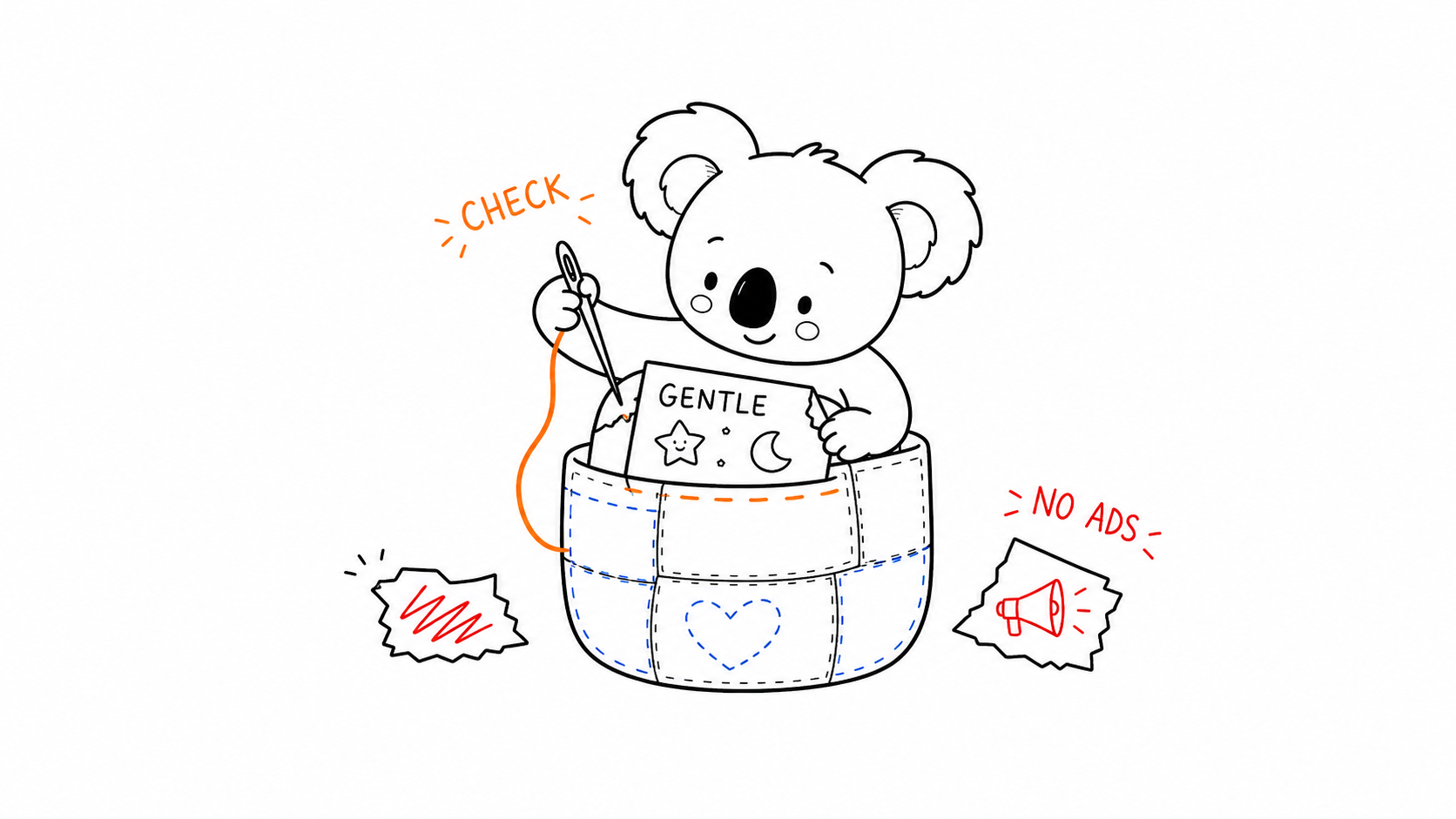
Advertising deserves particular attention. Third-party advertisements can interrupt a story and may lead children towards content or purchasing prompts that parents did not choose. An experience described as free from third-party advertising can remove one common source of interruption, although parents should still review the app’s current terms and in-app information for themselves.
Content quality also involves tone and coherence. A story can avoid obviously unsuitable material and still feel confusing or poorly matched to a preschooler. Read a few stories with your child before deciding whether the overall library meets your expectations.
If an app uses technology to assist with story development, find out whether people also rewrite, select or review the material. Technology-assisted creation does not by itself establish whether a story is appropriate. What matters is what editorial and safety checks happen before children encounter it.
Parents should remain involved, particularly when first using an app. Previewing a story gives you an opportunity to notice themes that may not suit your child’s current interests or sensitivities. No review system can account for every individual child, so your knowledge of your own family remains essential.
4. Choose an app that fits a real family routine
The most impressive app on paper may not be the most useful one at 7:45 pm. A practical bedtime story app should fit the routine your family can realistically maintain.
Begin by considering what you need the app to do. Perhaps you want to reduce the time spent searching for a story. You may want age-based choices, a regular reminder or a convenient supply of English stories. Define the need before evaluating extra features.
A simple routine might look like this:
- ●Receive or notice a daily reading reminder.
- ●Let the parent choose between two age-appropriate stories.
- ●Complete the usual bedtime preparations.
- ●Sit together and begin the selected story.
- ●Finish with the same brief goodnight phrase each evening.
The reminder does not make the routine happen by itself, but it can provide a useful prompt. Similarly, the story is not a sleep treatment. Its role is to give parent and child a familiar shared activity at a predictable point in the evening.
Keep the routine flexible. If your child is very tired, choose a shorter or familiar story. If they are especially interested, pause to discuss an illustration or ask what they think will happen next. Consistency is helpful, but it does not require performing every evening in exactly the same way.
It is also worth checking practical details. Is the app available in your country? Are the stories in a language your family uses? Is the monthly or annual price clearly stated? If there is a free trial, when will the first charge occur, and how can you cancel?
One relevant example is Gula Stories, designed for parents of children aged 3 to 8, with parents of 3- to 4-year-olds as its first content audience. Its current stories are in English and the library continues to grow.
The stories are created, improved and selected with AI assistance, then rewritten and reviewed by the team for children. Before release, they are reviewed for age suitability, with violence, sexual content and other unsuitable material excluded. The app and website describe the experience as free from third-party advertising. It also offers age-based story choices and daily reading reminders.
The app is available on iOS and Android outside mainland China, including the US, UK, Australia and New Zealand. In the US, the subscription costs USD 4.99 per month or USD 29.99 per year, with the same prices on iOS and Android. New users begin with a seven-day free trial. They can cancel during those seven days without being charged and continue using the trial until it ends; the first charge occurs after day seven.
These details make Gula Stories one option to evaluate against your family’s needs. They do not make it the automatic choice for every child.
Quick comparison checklist
| Question | What to look for |
|---|---|
| Is the age range clear? | Specific guidance for preschool-aged children |
| Are stories easy to choose? | Useful categories, summaries or age-based options |
| Does the content suit your child? | Clear plots, accessible language and engaging themes |
| Is the experience low-distraction? | Simple navigation and few interruptions |
| Are stories reviewed? | A stated process for age suitability and content safety |
| Is unsuitable material excluded? | Clear information rather than vague assurances |
| Are there third-party ads? | Transparent advertising information |
| Can it support a routine? | Fast story selection and practical reminders |
| Is the language suitable? | Stories available in a language your family uses |
| Are costs transparent? | Clear prices, trial length and charging terms |
| Does your child respond well? | Interest, understanding and willingness to participate |
| Does it work for you? | A process you can comfortably repeat on busy evenings |
FAQ
What makes a bedtime story app appropriate for a 3-year-old?
Look for clear language, a simple plot, a small cast of characters and themes that are easy to understand. The app should also help parents identify age-appropriate stories quickly. Because development varies, try several stories and observe your child’s interest and comprehension.
Should a 4-year-old choose the story?
Offering a limited choice can be useful. Instead of presenting an entire library, select two suitable stories and let your child choose between them. This gives them some involvement without making the decision overwhelming or unnecessarily long.
Can a bedtime story app make my child fall asleep?
No app can guarantee sleep. A story app can support a gentle and familiar routine, but it should not be presented as a treatment for anxiety, fear of the dark, bedtime refusal or other sleep-related difficulties.
Are more stories always better?
Not necessarily. The suitability, organisation and review of the content matter more than a large total. A smaller collection of well-matched stories may be more useful than a vast library that is difficult to navigate.
Should I avoid stories created with AI assistance?
The use of AI assistance alone does not tell you whether stories are suitable. Look at the complete process: whether stories are rewritten, selected and reviewed by people, whether age suitability is checked and whether inappropriate material is excluded.
How can I keep an app from becoming distracting at bedtime?
Choose the story in advance, silence unrelated notifications and keep the focus on reading together. A simple app interface also helps. If your child becomes more interested in tapping through screens than following the story, adjust how and when the device is used.
Is a daily reading reminder useful?
It can be. A reminder may help make story time part of a family routine, especially on busy evenings. It is only a prompt, however; parents can decide whether reminders suit their schedule.
What should I check before starting a free trial?
Confirm the trial length, the date of the first charge, the monthly or annual cost and the cancellation terms. Set your own reminder if you want time to decide before billing begins.
Conclusion
The right bedtime story app for 3- to 4-year-olds should make story time easier to begin, not more complicated. Prioritise age fit, calm design, transparent content safeguards, freedom from disruptive advertising and a practical place within your existing routine.
Test the experience with your child rather than relying only on a feature list. Notice how quickly you can find a suitable story, whether your child can follow it and whether you would comfortably use the app again on a tiring evening.
Gula Stories is one relevant example, with English stories, age-based choices, daily reminders, age-suitability review and an experience described as free from third-party advertising. Compare those characteristics, along with its subscription terms, against other options and your family’s preferences.
A bedtime story app does not need to promise dramatic results. Its most useful role may be much simpler: helping a parent and child find a suitable story and share a gentle moment together.