
Calming Stories for Kids: Calm-Down Tales for Toddlers
After a stimulating day, toddlers usually benefit from a short, predictable story with gentle language, familiar actions
Key Takeaways
- ●After a stimulating day, toddlers usually benefit from a short, predictable story with gentle language, familiar actions, and a reassuring ending.
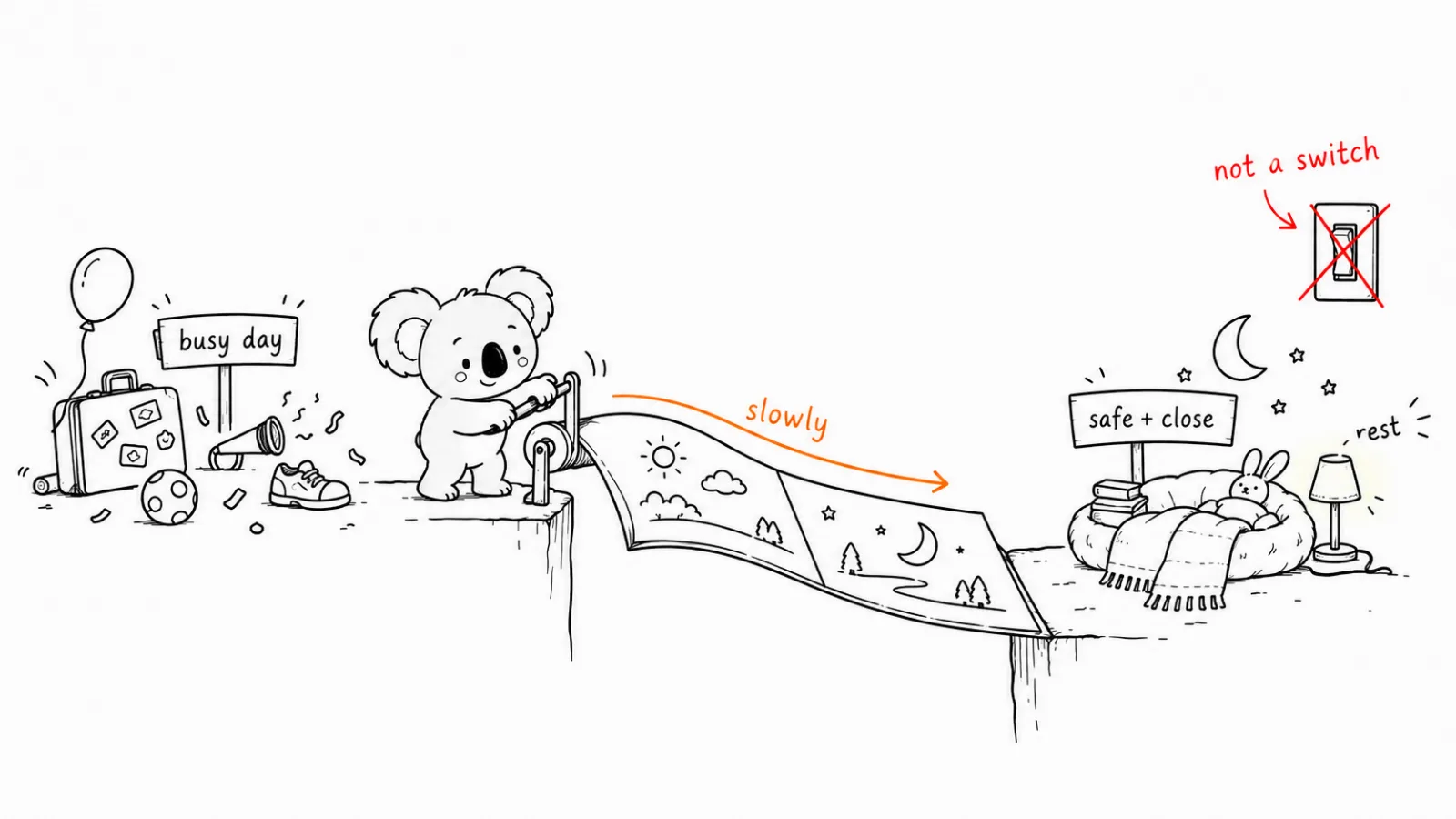
- ●The purpose of a calm-down story is not to force sleep. It is to help a child move gradually from activity and novelty toward safety, connection, and rest.
- ●On trips, familiar bedtime cues often matter more than finding a new or elaborate book. Repetition can be especially comforting in an unfamiliar room.
- ●Effective bedtime stories for travel and holidays avoid suspense, loud surprises, complicated plots, and promises that tomorrow will be endlessly exciting.
- ●A simple story can be adapted to a hotel, family visit, camping trip, or journey home without turning bedtime into another high-energy event.
1. Introduction
Busy days can be enjoyable and exhausting at the same time. A toddler may spend hours meeting relatives, visiting attractions, eating unfamiliar food, missing a nap, or moving between noisy environments. When bedtime arrives, that child may look tired but behave as if they have gained a new supply of energy.
This does not necessarily mean the child is unwilling to sleep. Toddlers often need help making the transition from stimulation to rest. They may replay the day through movement, repeated questions, requests for another drink, or resistance to separation. Travel can intensify the challenge because the room, bed, sounds, and evening routine may all be different.
Calm-down stories offer a practical bridge. A well-chosen story slows the pace of the evening, gives the child a predictable sequence to follow, and ends in a place of emotional safety. It can also acknowledge the day without inviting the toddler to relive every exciting moment.
This guide explains how to choose, tell, and adapt bedtime stories for travel and holidays. It also provides a reusable story structure for parents and caregivers who need something simple after a long day away from home.
2. What Makes a Story Calming for a Toddler?
The most effective calm-down stories are usually simple, repetitive, and emotionally secure. Their plots move toward stillness rather than toward a dramatic resolution.
A toddler does not need a complicated lesson at bedtime. After a demanding day, following multiple characters, locations, or problems may require more attention than the child can comfortably give. A smaller story world is easier to process: one character, one familiar goal, a few repeated actions, and a quiet ending.
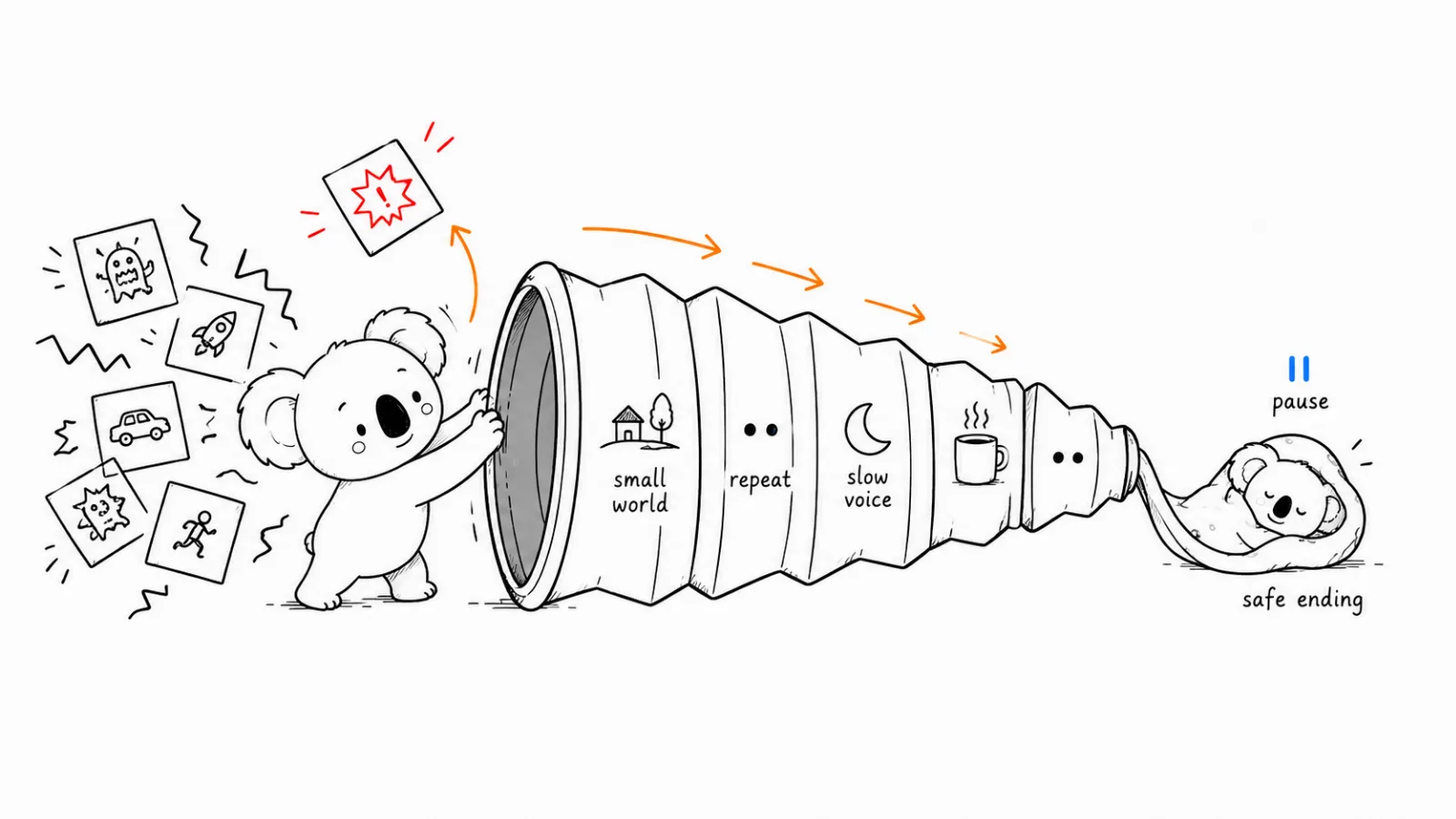
Useful features include:
- ●Short sentences that are easy to follow
- ●Familiar objects, such as a blanket, toy, moon, or bed
- ●Repeated phrases that signal what comes next
- ●Gentle sensory details, such as dim light or soft rain
- ●A problem that feels manageable rather than frightening
- ●A clear ending in which the character is safe and resting
For example, a story about a little rabbit returning to its burrow can repeat a sequence: the rabbit puts away its shoes, drinks some water, finds its blanket, and listens to the wind. Each action reduces activity. The story does not need a surprise visitor or a final adventure.
The reader’s delivery also matters. A calm story can become stimulating if it is performed with sudden sound effects, rapid questions, or exaggerated voices. Read slightly more slowly than usual, keep the volume steady, and allow brief pauses. The goal is connection, not performance.
Use Repetition as a Bedtime Cue
Repetition gives toddlers something they can anticipate. A recurring line such as “The day was finished, and the little bear was safe” can appear after each stage of the story.
Predictability is particularly valuable during travel. When the surroundings change, a familiar sentence, book, or character can remain constant. Repetition does not make a bedtime story ineffective; for a young child, knowing what happens next may be part of what makes it reassuring.
3. How to Tell Calm-Down Stories After an Exciting Day
Begin by briefly recognizing the child’s experience, then guide the story away from excitement. A useful principle is to mention the busy day without reconstructing it in vivid detail.
Suppose a toddler has spent the afternoon at a crowded family celebration. A bedtime story might begin:
“Little Fox had seen many faces and heard many sounds. Now the house was quiet, and Little Fox was ready to find one small, cozy place.”
This opening validates the character’s full day. It then immediately reduces the scale of attention—from many faces and sounds to one quiet place.
A practical calm-down story can follow five steps:
- ●
Name the transition.
The busy part of the day has ended. - ●
Reduce the story world.
Move from a crowded or active setting to one safe room, nest, tent, or bed. - ●
Release the day in small pieces.
The character can put away an object, say goodnight to a memory, or notice that sounds are fading. - ●
Repeat a reassuring cue.
Use the same sentence two or three times. - ●
End with rest, not another possibility.
Avoid hints about a new adventure beginning after the child falls asleep.
Match the Story to the Child’s State
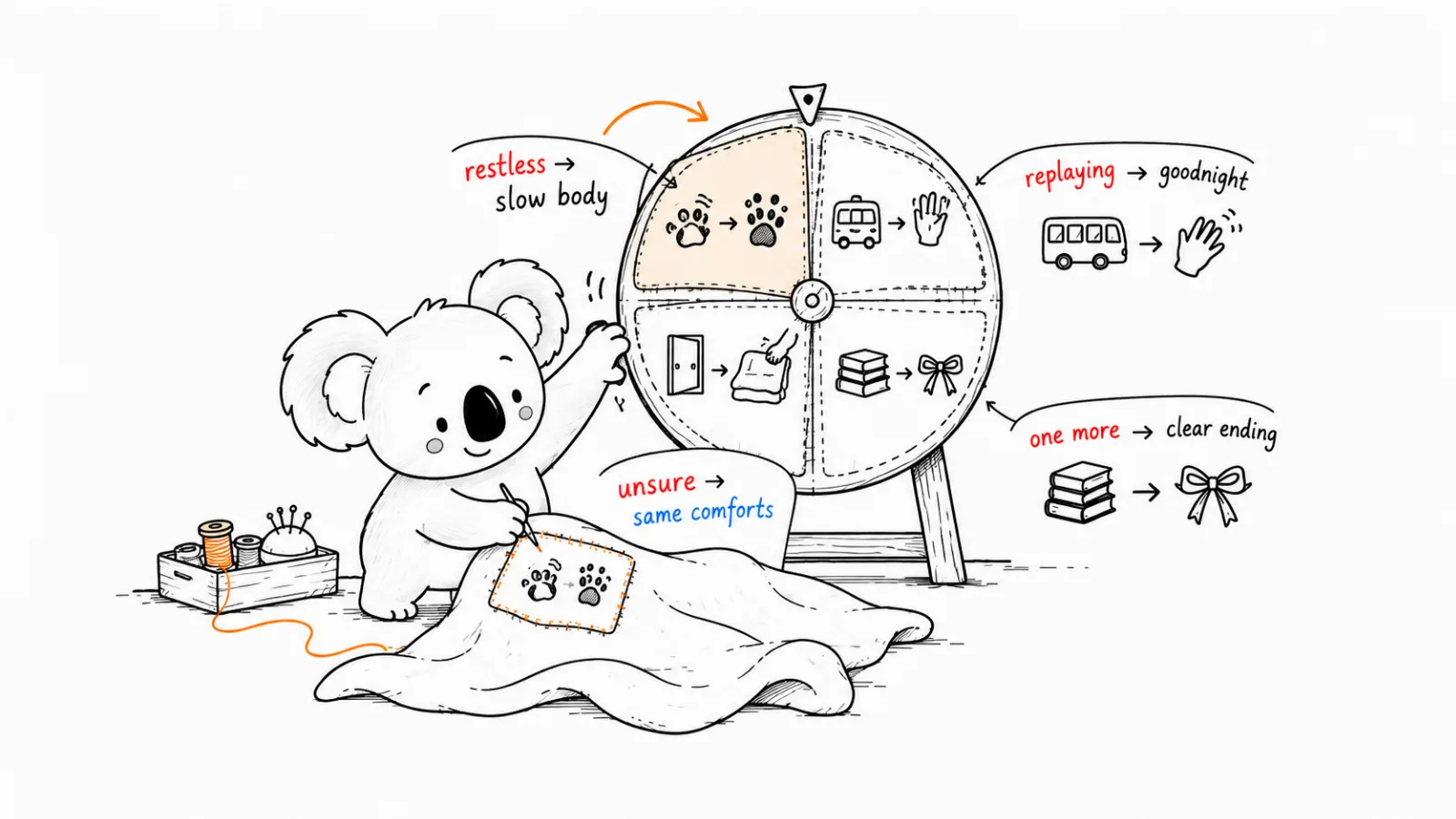
Different bedtime behaviors call for different approaches.
If the toddler is physically restless, include slow body-based actions in the story: a bear uncurls its paws, lowers its shoulders, and settles into soft leaves. The child can imitate these actions without turning the reading into a game.
If the toddler is talking constantly about the day, use a “goodnight to the day” structure. The character can say goodnight to the bus, the beach, the cousins, or the birthday cake. Keep each farewell brief and finish with the present moment.
If the toddler seems uncertain about the unfamiliar room, focus on continuity: the same caregiver is nearby, the same comfort object is present, and morning will come after rest. Do not dismiss the unfamiliarity. Make safety concrete within the story.
If the toddler becomes upset when the story ends, establish the limit before beginning: “We will read this story once, and then we will use our goodnight phrase.” A clear boundary is often easier to accept than a changing sequence of “one more” stories.
4. Bedtime Stories for Travel and Holidays
Good bedtime stories for travel and holidays create familiarity without making the trip sound more exciting at the exact moment a child needs to settle.
Travel changes many small details at once. A toddler may sleep in a portable cot, share a room, hear traffic outside a hotel, or notice hallway lights under the door. Stories can incorporate these details in a neutral, reassuring way.
For example:
“Milo Mouse slept in a room he had not seen before. The walls were different, and the little light by the door was new. But Milo had his blue blanket, his soft bear, and Papa’s quiet goodnight voice.”
The story does not claim that the room feels exactly like home. Instead, it identifies reliable elements within a new environment.
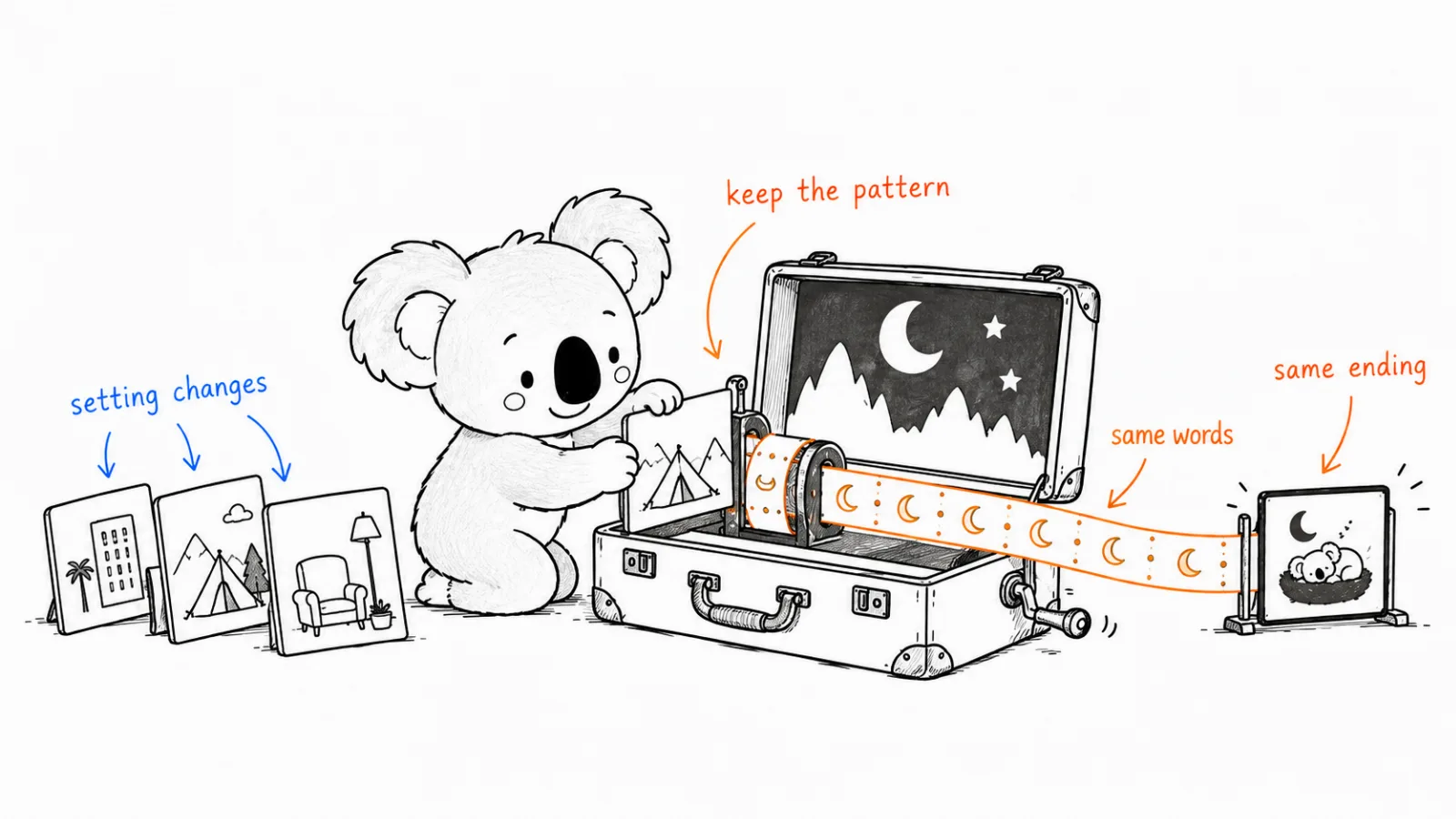
Adapt the Setting Without Changing the Structure
Use the same basic plot in different travel situations:
| Situation | Calming story setting | Reassuring detail | Ending cue |
|---|---|---|---|
| Hotel stay | A small bird rests in a new nest | Its familiar scarf is beside it | “New nest, same goodnight.” |
| Family visit | A rabbit sleeps in Grandma’s quiet room | A caregiver remains nearby | “Everyone was close, and Rabbit could rest.” |
| Camping trip | A bear settles inside a tent | The sleeping bag feels warm | “The forest grew still around the tent.” |
| Long journey home | A toy train returns to its station | Its work for the day is finished | “The train was home and quiet.” |
| Beach holiday | A turtle leaves the busy shore | The waves become softer in the distance | “One small wave, then rest.” |
The structure matters more than the destination. If a familiar story works at home, retain its repeated phrases and ending while changing only a few setting details. Too many new characters or references can make the story feel like another travel activity.
Pack One Familiar Book
A small selection is usually more practical than carrying an entire shelf. One familiar book can function as a stable bedtime object, especially if the caregiver uses the same reading order and closing phrase each night.
A digital book may be convenient, but the device itself can introduce distractions through notifications, brightness, games, or requests for videos. If reading from a phone or tablet, reduce avoidable interruptions and keep the interaction focused on the story. The important distinction is not simply paper versus screen; it is whether the format supports a quiet, predictable routine.
Keep Tomorrow Out of Tonight’s Story
Holiday schedules often encourage adults to preview the next activity: the zoo, pool, flight, boat ride, or family gathering. At bedtime, detailed previews may increase anticipation.
If the child asks about tomorrow, provide a brief, reliable answer when possible, then return to the present: “We will talk about the beach in the morning. Right now, the little turtle is resting.” Avoid making promises about weather, access, schedules, or experiences that may change.
5. A Reusable Calm-Down Story Method
Parents do not need to invent a polished tale every evening. The following framework can produce a short story using details already present in the child’s environment.
The REST Story Framework
| Step | Purpose | Example |
|---|---|---|
| R — Recognize the day | Acknowledge that the character has been busy | “Little Koala had climbed, waved, tasted, and explored.” |
| E — Enter a quiet place | Narrow the setting | “Now Little Koala returned to one small, dim room.” |
| S — Set down the day | Release objects, memories, or movement | “The hat went on the chair, the shoes went by the door, and the busy thoughts floated away.” |
| T — Trust the ending | Close with safety and rest | “Little Koala was warm, cared for, and ready to sleep.” |
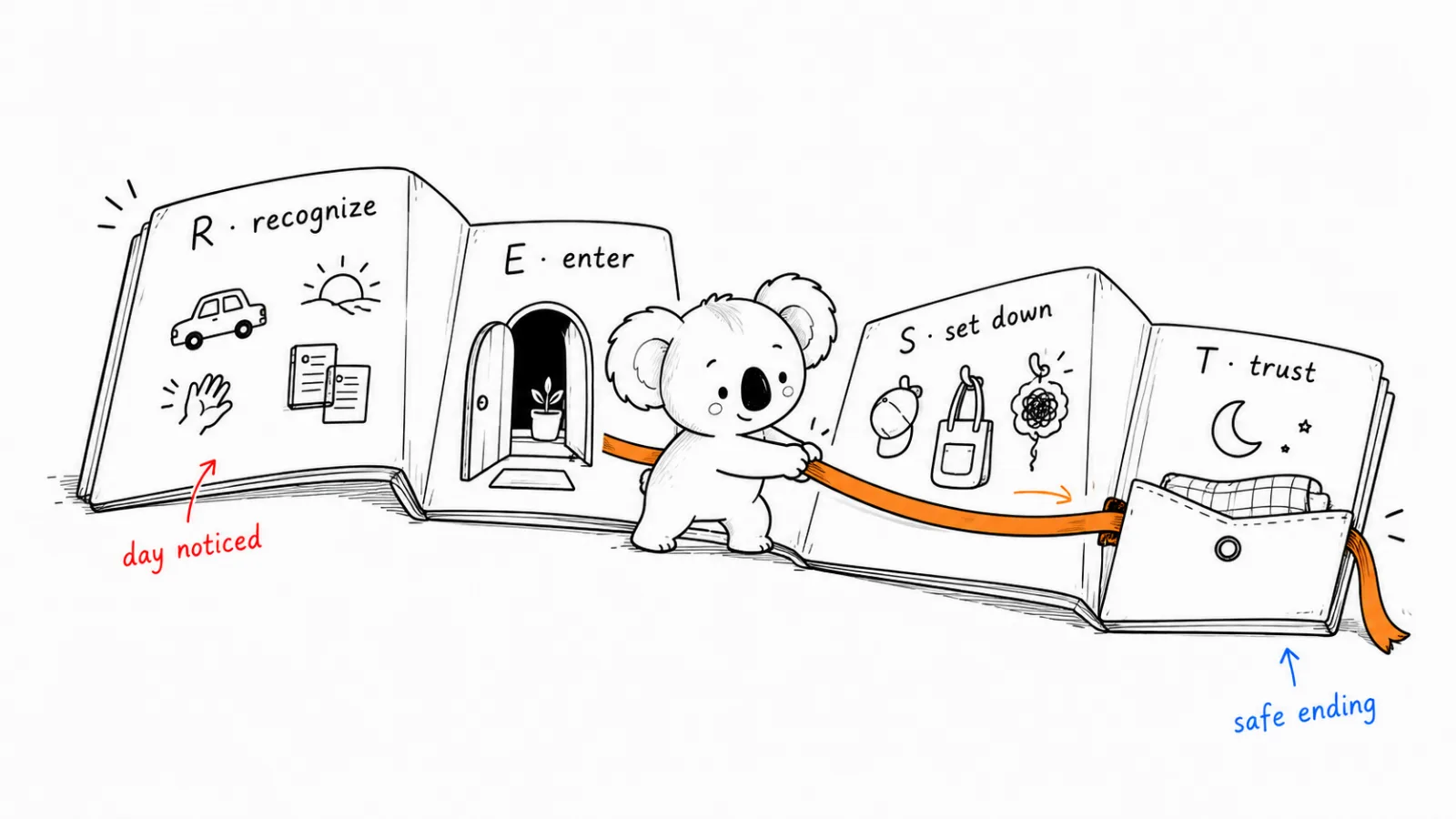
Here is a complete example:
The Little Koala and the Quiet Room
Little Koala had seen many things that day. There had been bright signs, rolling suitcases, new voices, and a long road.
Now the busy day was finished.
Little Koala entered a quiet room. It was not the room at home, but the soft green blanket was there. Mama Koala was there too.
Little Koala placed one shoe beside the other.
“Goodnight, busy feet,” Mama said.
Little Koala put the sun hat on the chair.
“Goodnight, sunny day,” Mama said.
Little Koala climbed under the green blanket. Outside, a car passed and became quieter and quieter.
The room was new. The goodnight words were the same.
Mama Koala whispered, “The day is done. You are safe. It is time to rest.”
Little Koala breathed in slowly and let the air go.
The road could wait. The bags could wait. Morning could wait.
Little Koala was warm, cared for, and still.
And the quiet room held one sleeping koala until morning.
What to Avoid
Certain story choices can work against a calm bedtime transition:
- ●Threatening characters, even if the hero eventually wins
- ●Problems involving separation from a caregiver
- ●Loud audience participation or competitive questions
- ●Long explanations of the next day’s plans
- ●Open endings that invite speculation
- ●Using the story as a warning about behavior or sleep
- ●Continuing indefinitely because the child requests new plot twists
A story should not be used to frighten a toddler into staying in bed. It is also not a substitute for attending to hunger, pain, illness, fear, or an unsafe sleeping environment. If a child’s bedtime distress is intense, persistent, or accompanied by concerning symptoms, seek appropriate professional guidance rather than relying on storytelling alone.
6. FAQ
What is a good length for a toddler’s calm-down story?
A short story that can be completed before the child loses track of its pattern is usually sufficient. The practical measure is not a fixed number of minutes. Look for a clear beginning, two or three calming repetitions, and a definite ending. On an overtired night, a familiar story of only a few paragraphs may work better than a longer book.
Should a bedtime story describe what happened during the day?
It can, but selectively. Mention one or two recognizable details to help the child feel understood, then move toward quieter images. Recreating every exciting event may reactivate the child’s attention. If the toddler wants to discuss the day in detail, that conversation can happen earlier in the evening or the next morning.
What if my toddler keeps interrupting the story?
Brief interruptions are normal. Answer simple concerns, then return to a repeated line such as, “The day is finished, and Little Bear is resting.” If the interruption becomes a game, calmly preserve the story’s boundary: finish the short version and move to the established goodnight routine.
Should we use a new story while travelling?
A new story can be enjoyable, but familiarity is often useful at bedtime. Pack or memorize at least one story the child already knows. If you introduce a travel-themed story, keep the structure simple and reuse the same ending on later nights.
7. Conclusion
Calm-down stories for toddlers after a busy day work best when they make the world smaller, slower, and more predictable. The story should recognize that much has happened, guide the character into a safe resting place, and finish without suspense.
When choosing bedtime stories for travel and holidays, prioritize familiar language, repeated cues, and emotionally secure endings over elaborate plots. Adapt only a few details to the hotel, family home, campsite, or journey. A consistent story pattern can become a portable part of the bedtime routine, helping a toddler move from a full day toward rest—one quiet sentence at a time.
Ready for calmer bedtimes?
Try Gula Stories free — 5 narrated bedtime stories, ad-free, for children ages 3-8.